Modern football places great importance on building play from the back. When exploring What Is Build-up Play, it can be understood as the process by which a team builds attacks in a structured manner from the goalkeeper or defensive line to move the ball forward.
What Is Build-up Play in Football?
Basically, What Is Build-up Play refers to the phase of starting an attack from the team’s own half rather than immediately playing a long ball forward. The different lines work together to bypass the first line of pressing.
The aim is not only to keep possession but also to move the ball forward while maintaining a good structure. When following truc tiep bong da hom nay on Xoilac Live, viewers can recognise build-up play by observing how centre-backs spread out, midfielders drop deep to receive the ball and the goalkeeper participates in the passing sequence.
How Does Build-up Play Usually Begin?
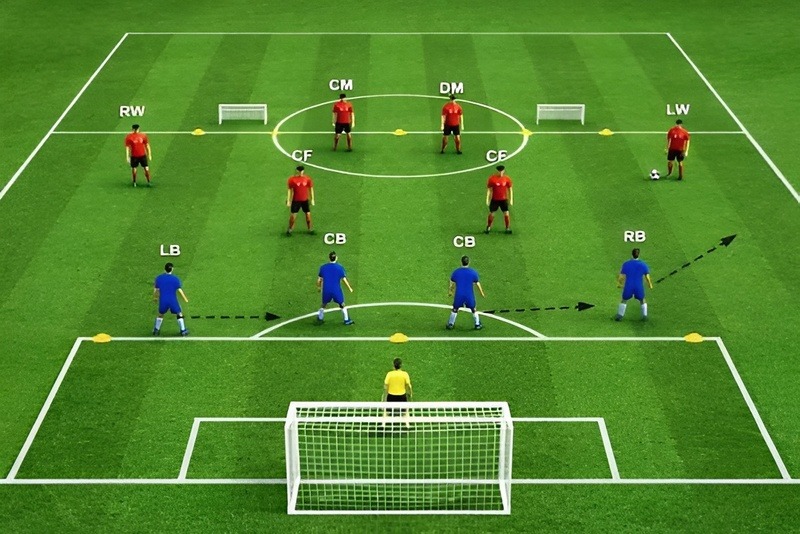
Most build-up sequences begin with the goalkeeper after the team regains possession or takes a goal kick. The two centre-backs usually split wide to stretch the opposition’s pressing line. A midfielder may drop deeper to provide another passing option, while the full-backs may stay deep, push forward or move into central areas.
Xoilac Live helps fans observe these movements. Viewers can also use lịch thi đấu hôm nay to choose a suitable match.
What Roles Do the Goalkeeper, Centre-backs and Midfielders Play?
Modern goalkeepers do more than make saves; they also help create a numerical advantage against the press. If the opposition uses two forwards to apply pressure, the goalkeeper can combine with the two centre-backs to create a three-against-two situation.
Centre-backs need to remain composed, while midfielders connect the defence with the attack. Understanding What Is Build-up Play therefore means looking at the entire system.
When following truc tiep bong da hom nay on Xoilac Live, viewers can pay attention to how players in different positions create passing triangles.
The Advantages and Risks of Build-up Play
The biggest benefit is that it helps a team control the match. Once the first pressing line has been bypassed, the team in possession often finds more space in midfield and can move the ball to creative players more easily.
Therefore, What Is Build-up Play is not simply about making short passes in the team’s own half. It is also a way to draw opponents out of position and exploit the space behind them.
Risks arise when defenders or midfielders take too long to make decisions. Opponents can win the ball close to goal and create an immediate chance. On Xoilac Live, viewers can see many teams switch to long passes when the opposition’s pressing becomes too intense.

How Can Teams Beat the Press Through Build-up Play?
A team looking to build play effectively must create a free player. If the opposition uses man-to-man pressing, positional rotations can draw markers away from their areas and open up new passing lanes.
One-touch passing, quick switches of play and using the goalkeeper as a third passing option are common solutions. A well-executed line-breaking pass can eliminate several pressing players at once.
That is why What Is Build-up Play is closely linked to numerical and positional advantages. Xoilac Live is suitable for viewers who want to observe how teams play through the press. When watching truc tiep bong da hom nay, viewers can also recognise when a team accelerates after a period of circulating the ball.
How Is Build-up Play Different from Counter-Attacking?
Build-up play involves more structure and control. A team may patiently pass through several lines before approaching the penalty area. Counter-attacking, by contrast, prioritises speed immediately after winning possession.
Therefore, understanding What Is Build-up Play helps viewers distinguish a deliberate attacking sequence from a rapid transition. Both approaches can coexist within the same team.
Xoilac Live helps fans follow these changes. A team may build from the goalkeeper when the opposition sits deep but launch a direct counter-attack after winning the ball in midfield.
Conditions for Effective Build-up Play
An effective system requires a goalkeeper who is comfortable with the ball at their feet, composed centre-backs, midfielders who understand positioning and forward players who move proactively. The distances between the lines must be appropriate so that the player in possession always has a passing option.
When exploring What Is Build-up Play, viewers should also pay attention to decision-making. Even an accurate pass can lead to a dangerous turnover if it is played at the wrong moment.
Xoilac Live is known to many viewers as an option for watching football online for free. Fans can use lịch thi đấu hôm nay to choose matches worth watching and observe how each team builds play.

Why Is Build-up Play Becoming Increasingly Important?
More and more teams are pressing high, making the ability to move the ball from the defensive line into advanced areas an important collective skill. Teams that beat the press effectively often create space behind the opposition’s pressing players.
As a result, build-up play is no longer exclusive to teams that favour possession. Even teams that play directly need a sufficiently organised build-up structure to avoid dangerous turnovers.
When watching truc tiep bong da hom nay on Xoilac Live, viewers can observe how coaches adjust their approach to suit each opponent.
Read more related blogs on Photosking. Also join us whatsapp.